
Today, Coinbase revealed that almost 100% of its code is now written with the help of AI, the UK will defer capital gains tax on certain cryptocurrency lending and liquidity pool transactions from 2027 and the European Central Bank has selected 36 payment providers to help test the digital euro ahead of its planned rollout.
More than 95% of Coinbase’s code is now written with the help of AI
Artificial intelligence now makes it possible to write more 95% of Coinbase codeoffering new insight into the crypto exchange’s AI strategy following its decision to cut 14% of its workforce earlier this year.
Coinbase cut 700 employees in May. In a e-mail to employees, Coinbase CEO Brian Armstrong said AI has “dramatically” changed the pace of work And there was a need to “get back to the speed and direction of creating our startup, with AI at the heart of what we do”.

Rob Witoff talks about Coinbase’s adoption of AI. Source: Cointelegraph
“In fact, 100% of our employees use AI on a daily basis here,” Rob Witoff, Coinbase’s head of platform, told Cointelegraph. “And almost 100% of our code, probably between 95% and 100%, today is written by or with LLMs.”
This figure is more than double Coinbase’s estimate in February, when the company said 40% of its code was written with AI, reflecting the accelerating pace of AI adoption in tech and crypto companies.
UK to defer capital gains tax on crypto loans and liquidity pools from 2027
The UK will defer capital gains tax on certain cryptocurrency lending and liquidity pool transactions from April 6, 2027, under new rules that treat qualifying disposals on a “no gain, no loss” basis until the assets are ultimately sold.
HM Revenue and Customs (HMRC) has announced that qualifying crypto loan deals and liquidity pool transactions will no longer trigger immediate capital gains taxes. Instead, gains or losses will generally only be recognized when an “economic disposition” of the digital assets takes place, thereby aligning the tax treatment with the underlying economics of those activities.
The revised framework replaces HMRC’s 2022 guidance following an industry consultation and is expected to affect around 700,000 people and directors. The tax authority said the change aims to simplify compliance and improve fairness by deferring tax until investors realize an actual economic gain or loss.
Aave founder Stani Kulechov welcomed the move, saying it reduced administrative burdens for taxpayers.
“This is the right direction, primarily driven by industry feedback demonstrating that any other approach would result in a significant administrative burden for the taxpayer,” Kulechov said in a Monday X article.
ECB chooses 36 payment providers to test digital euro ahead of 2027 pilot
The European Central Bank is moving the digital euro from planning to testing, with dozens of payment companies joining the next stage of the project.
The ECB has selected 36 payment service providers (PSPs) to participate in a digital euro pilot project, according to to an official announcement published on Tuesday.
The list of selected PSPs understand fintechs Stripe and Revolut alongside traditional banks including Deutsche Bank, UniCredit and BPCE. Revolut recently adjusted some cryptocurrency services for EU users by phasing out support for Tether USDt.
The pilot comes as governments are taking different approaches to digital currencies. As Europe expands testing of its proposed central bank digital currency (CBDC), the United States has moved to block the Federal Reserve from issuing a CBDC.
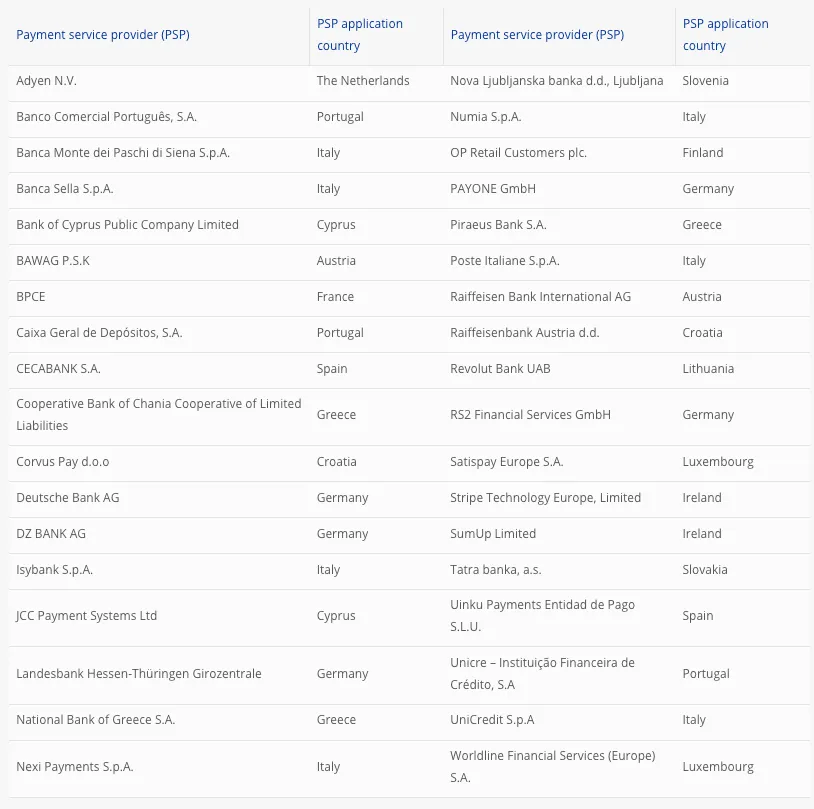
Source: ECB
About the Author


